Two homes can have almost exactly the same square footage and still feel completely different.
Walk into one and you might immediately think, Wow, this feels spacious.
Walk into another and wonder where all the space went.
It’s easy to assume the difference is simply size. More square footage should mean more room, right?
Not always.
The way a home uses, reveals, and connects its space can change how large it feels. Layout, natural light, ceiling height, furniture, storage, and even what you can see from the front door can influence your perception of a room.
In other words, sometimes a home doesn’t need more space.
It just needs to feel like it has more of it.
Square Footage Doesn’t Tell the Whole Story
Square footage is one of the first numbers people look at when comparing homes.
And for good reason—it matters.
But it doesn’t tell you how that square footage is arranged.
Imagine two 2,000-square-foot homes.
In the first, you walk through a long hallway, turn into a small kitchen, pass through another doorway, and enter the living room.
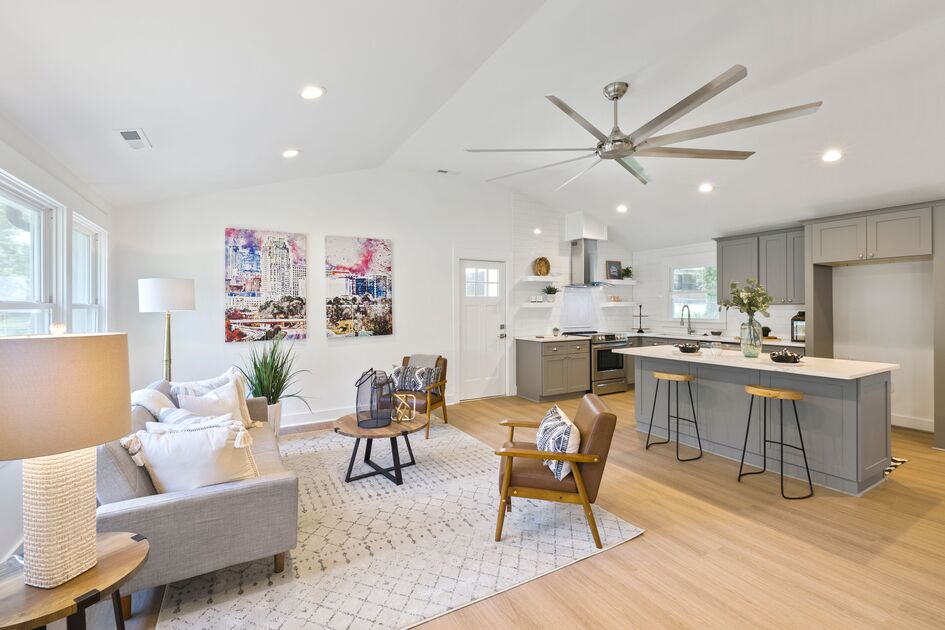
In the second, the kitchen, dining, and living areas connect naturally, allowing your eyes to travel from one space into another.
Same number.
Very different experience.
Long hallways, oversized transition areas, awkward room connections, and closed-off spaces can consume square footage without necessarily making the home feel more spacious. Efficient layouts can make better use of the same footprint.
That’s why sometimes the smaller home feels bigger.
Your Eyes Matter More Than You Think
When you walk into a room, you’re not measuring it with a tape measure.
Your brain is quickly processing what it sees.
Can you see across the room?
Can you see into the next room?
Is there something blocking your view?
Does the floor continue naturally?
Can your eyes reach a window or an outdoor view?
These visual connections create something designers often call flow.
When sightlines are uninterrupted, a home can feel more expansive because your eyes aren’t constantly stopping at walls, furniture, or visual clutter.
This is one reason an open kitchen connected to a living room can feel much larger than two separate rooms with the exact same combined square footage.
Look Up
Sometimes the secret to making a room feel larger isn’t in the floor.
It’s above your head.
Ceiling height can dramatically affect how a room feels. Taller ceilings draw the eye upward and create more vertical volume, making a space feel less confined.
This is why a modest room with a high ceiling can sometimes feel more impressive than a larger room with a low ceiling.
You don’t necessarily need a huge room.
Sometimes you just need a little more breathing room above it.
Natural Light Is a Space-Maker
Few things change the feeling of a room faster than natural light.
A bright room tends to feel more open and inviting, while a darker room can feel smaller because shadows visually compress the space.
Windows also do something else.
They give your eyes somewhere to go.
Instead of stopping at a wall, your view continues toward a backyard, trees, a garden, or the sky.
That connection to the outdoors can make the interior feel like it extends beyond its actual walls.
A window isn’t just a source of light.
Sometimes, it’s another room for your eyes.
The Furniture Can Take Away the Room
You can have a beautiful home with plenty of square footage and still make it feel cramped.
How?
Put an enormous sectional in a small living room.
Add a giant coffee table.
Fill every wall.
Place furniture where it blocks pathways.
Add too many decorative pieces.
Suddenly, the room feels smaller.
Furniture doesn’t just occupy physical space. It occupies visual space.
Properly scaled furniture, clear walking paths, and intentional placement can allow more of the floor and room to remain visually open.
Sometimes the solution isn’t buying a bigger sofa.
It’s realizing that the sofa you already own is eating the room.
Clutter Has a Square-Footage Problem
A countertop covered in appliances.
A chair covered in clothes.
Shoes scattered by the front door.
Decorative objects covering every shelf.
None of these things technically change the size of your home.
But they can change how large it feels.
Visual clutter creates more things for your eyes to process. Thoughtful storage helps keep everyday objects contained, allowing the architecture and layout of a room to become more visible. Built-in cabinets, overhead storage, multifunctional furniture, and otherwise unused spaces can all help.
A home doesn’t necessarily need fewer belongings.
It needs a place for them to go.
One Floor Can Make a Home Feel Like Several Rooms
Here’s another subtle trick: continuity.
When the same or similar flooring runs through connected areas, your eye doesn’t encounter as many visual stopping points.
A living room transitions into a dining area.
The dining area transitions into the kitchen.
The flooring continues.
The spaces feel connected.
When every room has a completely different floor, color, and visual style, each transition can make the home feel more divided. Consistent finishes can create a stronger sense of continuity.
It doesn’t mean every room needs to look identical.
It simply means the home can benefit from having a visual conversation between its spaces.
The Outdoors Can Become Part of the Room
One of the most effective ways to make a home feel larger is to stop treating the backyard as completely separate from the house.
Large windows.
Glass doors.
Sliding doors.
A covered patio.
A small courtyard.
Even a carefully framed garden view.
These elements can blur the boundary between indoors and outdoors, making the usable environment feel larger than the interior footprint alone.
A small living room overlooking a beautiful backyard can feel surprisingly expansive.
The room ends where the wall ends.
The view doesn’t.
Bigger Isn’t Always Better
This is perhaps the most interesting part.
We’re often trained to think that more square footage automatically means a better home.
But a larger home can have wasted hallways, awkward corners, unused rooms, poor lighting, and furniture that makes the space difficult to navigate.
A smaller home can be thoughtfully designed around the way people actually live.
Every room has a purpose.
Storage is intentional.
Light reaches the spaces that need it.
Rooms connect naturally.
The furniture fits.
The view is used.
Suddenly, a home that looks modest on paper can feel surprisingly generous in person.
New Era Homes makes a similar point: smaller homes don’t necessarily have to feel like a compromise when layout, light, storage, and indoor-outdoor connections are thoughtfully considered.
The Best Kind of Space Is Useful Space
There’s a difference between having more space and experiencing more space.
A 500-square-foot room that is beautifully organized and easy to move through can feel more comfortable than a 700-square-foot room filled with oversized furniture.
A hallway doesn’t become valuable simply because it is large.
A room doesn’t become useful simply because it is large.
What matters is whether the space supports the way you live.
Do you have room to move?
Room to gather?
Room to breathe?
Room to store the things you actually use?
Room for sunlight?
Room for the people who live there?
Those questions can tell you more about a home’s livability than a number on a listing.
When You Walk Into a Home, Don’t Just Count the Rooms
The next time you tour a home, try something different.
Don’t immediately look at the square footage.
Instead, pay attention to how the home feels.
Look at where your eyes naturally travel.
Notice how much light enters the room.
Look at the ceiling.
Notice whether you can see from one living space into another.
Pay attention to how easily you move from room to room.
Look at the furniture and whether it overwhelms the space.
Notice the windows and what they frame outside.
Then ask yourself:
Does this home feel like it has enough space for my life?
Because that’s ultimately the number that matters.
A home doesn’t have to be enormous to feel generous.
Sometimes, the smartest homes simply know how to make every inch count.
And that’s the secret:
A home can be small in square footage and still feel big in every way that matters.
References — APA 7th Edition
Hurry, B. (2026, March 10). Why some homes feel bigger even when they’re the same size. Hurry Home Team. Hurry Home Team
New Era Homes. (2026, April 24). Designing a home that feels bigger than it is. New Era Homes
Limpia Services. (n.d.). Why some homes feel bigger than they actually are. Limpia Services